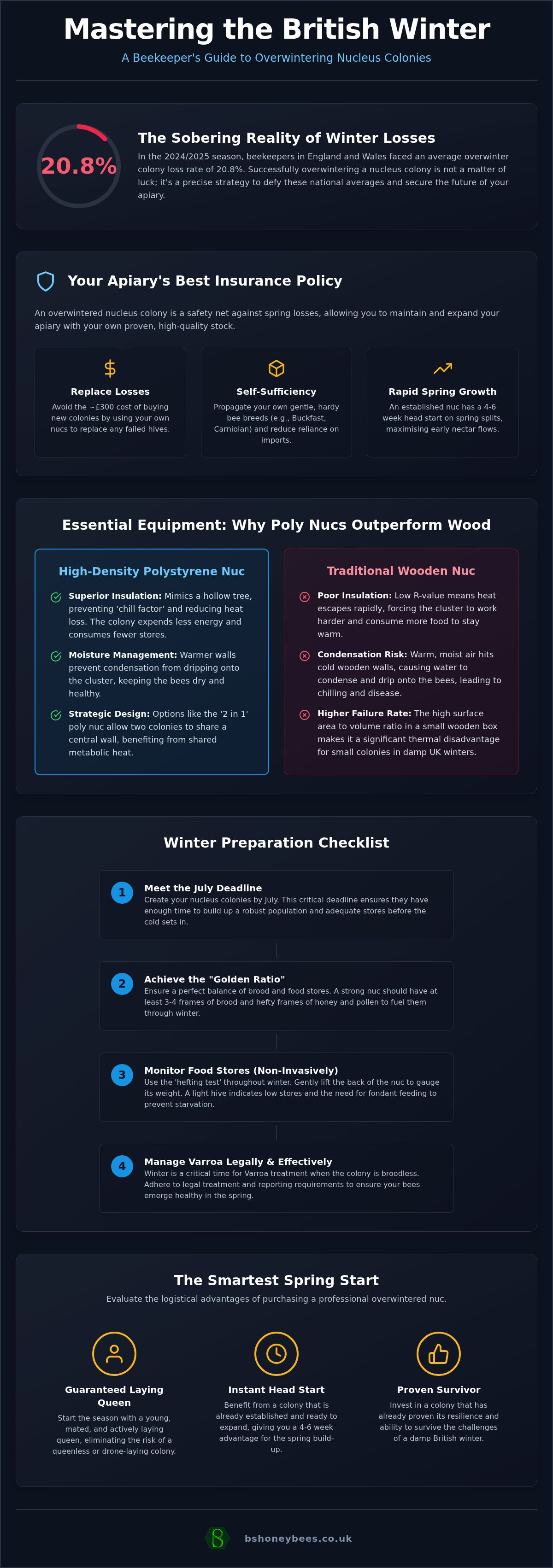
Did you know that average overwinter colony losses in England and Wales climbed to 20.8% during the 2024/2025 season? For many beekeepers, the sight of a silent, cold hive in March is a heartbreaking reality. You've likely felt that nagging anxiety as the temperature drops, wondering if your small nucleus colony has enough stores or if the damp British winter is taking its toll. Successfully overwintering a nuc uk requires more than just luck; it demands a precise, proactive approach to insulation and nutrition.
We understand the fear of isolation starvation and the confusion surrounding late-season feeding. This guide provides the specialist techniques you need to defy the national averages and ensure your bees emerge stronger than ever for the 2026 season. We will explore the critical role of high-density poly nucs, the legal requirements for Varroa management, and the exact steps to transform a vulnerable five-frame colony into a thriving spring powerhouse. Prepare to move beyond basic survival and master the logistics of sustainable apiary expansion.
Key Takeaways
- Learn how nucleus colonies act as a vital insurance policy, allowing you to replace winter losses in full-sized hives without the expense of sourcing new stock.
- Discover why high-density polystyrene is the gold standard for overwintering a nuc uk, providing the thermal insulation necessary to prevent damp and cluster failure.
- Master the "Golden Ratio" of brood and stores whilst adhering to the critical July deadline for creating colonies that are robust enough to survive.
- Understand the precision required for winter management, including the non-invasive hefting test to monitor food levels and legal Varroa reporting requirements.
- Evaluate the logistical advantages of purchasing a professional overwintered nuc to ensure a guaranteed laying queen and a head start for the 2026 spring season.
Why Overwintering a Nuc is the UK Beekeeper's Best Insurance Policy
Every serious beekeeper understands the sting of spring losses. In the UK, where winters are damp and unpredictable, relying solely on your main hives is a gamble. This is where understanding What is a Nucleus Colony (Nuc) becomes essential. A nucleus colony, or nuc, is essentially a miniature version of a full-sized colony, consisting of 5 or 6 frames of bees, brood, and food. It is a powerhouse in a small box, designed for flexibility and resilience.
Overwintering a nuc uk serves as your best insurance policy. Think of it as a safety net for your apiary. If a full-sized National hive fails to emerge in April, you don't need to spend £300 on a new colony from an external supplier. You simply move your nuc into the empty hive. It is about self-sufficiency and logistical precision. By propagating your own gentle honey bee breeds UK, such as F1 Buckfast or Carniolans, you reduce your dependence on imported bees and maintain higher standards within your apiary. BS Honey Bees Ltd specialises in these hardy strains to ensure your insurance policy is as robust as possible.
Spring build-up is another critical factor. Whilst packages of bees are popular, they often struggle during the erratic weather of a British April. An overwintered nuc already has an established brood cycle and a queen ready to expand. It hits the ground running, often outpacing packages by several weeks. This head start is the difference between a mediocre season and a record-breaking honey harvest.
The Strategic Advantage of Small Colonies
Maintaining small colonies offers a significant tactical edge. If you find a drone-layer or a queenless hive in March, you have an emergency queen ready to go. It is much easier to monitor a 5-frame unit for health and temperament than a massive double-brood National hive. You can manage genetic diversity across your apiary with ease, ensuring your stocks remain productive and calm.
Overwintered Nucs vs. Spring Splits
Patience is a virtue, but in beekeeping, timing is everything. Overwintered colonies typically have a 4 to 6-week head start over spring splits. While a split is busy building comb and raising its first larvae, an overwintered queen is already expanding her brood nest. An overwintered nuc is a colony that has proven its resilience by surviving the previous year's late-season challenges and winter months. For those looking to expand quickly, purchasing a professional overwintered 5 frame nucleus ensures you start the season with a proven survivor. Overwintering a nuc uk gives you the momentum needed to maximise the early nectar flows.
Essential Equipment: Why Poly Nucs Outperform Wood in British Winters
Small clusters face a mathematical disadvantage during a British winter. In a standard wooden box, the surface area to volume ratio is high. This means heat escapes faster than the bees can generate it. For overwintering a nuc uk, this thermal loss is often the primary cause of colony failure. High-density polystyrene (EPS) has surged in popularity amongst UK beekeepers because it addresses this specific vulnerability with logistical precision. It provides the thermal stability that traditional cedar simply cannot match.
The Science of Hive Insulation
Wood is a poor insulator. It has a low R-value, which means heat transfers through the walls rapidly. In contrast, poly nucs offer superior thermal properties that mimic the natural insulation of a hollow tree. This prevents the 'chill factor' from killing bees on the outer edges of the cluster. When bees don't have to vibrate constantly to maintain brood-rearing temperatures, they consume significantly fewer stores. This efficiency is vital. Moisture management is equally critical. Wooden hives often suffer from internal condensation when warm air hits cold walls. Poly walls stay warmer, keeping the moisture in the air until it can be vented out, rather than allowing it to drip onto the cluster.
Choosing the Right Nuc Box
Your choice of equipment dictates your spring success rate. Look for boxes with integrated feeders and secure, reduced entrances to prevent late-season robbing. The 2 in 1 poly nuc is a strategic masterstroke for the British climate. It allows two separate colonies to share a central thermal wall. By huddling against the same divider, they benefit from shared metabolic heat. This effectively doubles their chances of survival within a single footprint. If you are just starting your journey, 'B-Grade' stock can be a cost-effective entry point, offering the same high-level insulation for your overwintering a nuc uk experiments.
Compatibility with your existing kit is non-negotiable. Ensure your nuc frames are standard British National size so they can be transferred seamlessly into full-sized equipment come April. Investing in professional-grade gear now saves you the cost and frustration of replacement bees later. You can browse our British National hives and frames to ensure your entire apiary is standardised for maximum efficiency.
The Step-by-Step Guide to Preparing Your Nuc for the Cold
Success in overwintering a nuc uk begins long before the first frost. July is your hard deadline for creating or consolidating a nucleus colony intended for the winter months. Any later and the queen won't have sufficient time to raise the "fat bees" necessary to survive until April. Queen quality is paramount during this window. Ensure your nuc is headed by a vigorous F1 Buckfast or Carniolan queen. These strains are selected for their prolific late-season laying and frugal use of stores, which are essential traits for a small colony's survival.
Creating the Perfect Nuc Balance
Achieving the "Golden Ratio" within your 5 or 6-frame unit is a matter of logistical precision. You must select 2 to 3 frames of emerging brood. These young bees will form the core of the winter cluster. Include at least one frame of empty, drawn comb. This provides the queen with immediate space to lay without the colony needing to expend energy drawing out fresh wax. By the end of September, the nuc must also contain at least two full frames of capped honey or syrup stores. This balanced architecture ensures the cluster has both the population and the fuel to endure January's bite.
Autumn Feed and Consolidation
Timing your feeding regime is critical for overwintering a nuc uk successfully. Use rapid feeders to administer thick 2:1 sugar syrup throughout August and September. This allows the bees to process and cap the stores whilst the weather is still warm enough for them to fly. Monitor the temperature closely. Once the ambient temperature consistently stays below 10 degrees Celsius, the bees will struggle to process liquid feed. At this point, you must switch to fondant. Place the fondant directly over the cluster to prevent isolation starvation. A nuc should weigh roughly 12-15kg before entering December. This weight gives you the confidence that the colony has the resources to reach the first early willow pollen in spring.
Winter Management: Feeding and Varroa Control
Hefting is your primary diagnostic tool between December and March. This simple technique involves gently lifting one side of the hive to judge its weight. Opening a small colony in sub-zero temperatures is a mistake that can lead to immediate cluster failure. If the box feels light, you must act. Overwintering a nuc uk requires vigilant monitoring because a 5-frame unit has less margin for error than a full-sized hive. Beyond food, you must defend against physical threats. Fit a mouse guard in October to prevent rodents from nesting in the warm cluster. In areas with high woodpecker activity, a simple wrap of plastic netting prevents birds from drilling through the soft walls of a poly nuc.
Emergency Feeding Strategies
Isolation starvation is a silent killer in the British winter. Bees are reluctant to move even two inches away from the cluster's warmth to reach stores during a cold snap. To prevent this, use the 'contact' method. Place fondant directly over the hole in the crown board or, better yet, directly onto the top bars of the frames where the bees are huddling. This ensures they don't have to break the cluster to feed. Never use liquid syrup during the winter months. Bees cannot process the moisture when it's cold, which often leads to dampness and fatal bouts of dysentery within the small colony.
Mite Control in Small Units
Nucs are particularly vulnerable to mite-vectored viruses because their smaller population cannot easily absorb the loss of winter bees. Timing your winter treatment for the broodless period, typically late December, is essential for success. Whilst Oxalic acid trickling is a common hobbyist method, sublimation is often preferred for overwintering a nuc uk as it doesn't involve opening the hive or wetting the bees.
Be precise with your dosage. A 5-frame colony has significantly less internal volume than a standard National hive. If you are trickling, adjust the volume of the solution to match the number of occupied seams of bees. Over-saturating a small cluster can lead to queen loss or chilled brood. For more on maintaining a healthy hive, see our guide on mated queen bees UK. Remember that you are legally required to record all medicinal treatments and keep these records for five years. To ensure your apiary is equipped for the season ahead, order your British National frames and winter supplies from our specialist shop.
Buying vs. Making: Why an Overwintered Nuc is the Smartest Spring Start
Attempting to overwinter your first small colony is a rewarding challenge, but it is also a high-stakes gamble with your apiary's future. For many, the DIY approach seems cost-effective until you factor in the logistics. Between purchasing high-density poly nucs, feeders, and quality frames, the initial investment mounts quickly. When you add the cost of specialised autumn feed and the very real risk of colony loss, the financial gap between making and buying narrows significantly. Choosing a professional route offers a level of predictability that DIY simply cannot guarantee.
The primary advantage of a purchased posted overwintered 5 frame nucleus is the certainty of a laying queen. Whilst a DIY nuc might struggle with a failing queen or isolation starvation, a professional unit arrives in April 2026 with a proven survivor at the helm. This predictability allows you to plan your season with confidence. You know exactly when your bees will arrive, ready to expand into a full British National hive just as the first major nectar flows begin.
Evaluating the Cost of Overwintering
Success in overwintering a nuc uk requires a significant commitment of time and resources. You must manage Varroa levels, monitor stores, and ensure the colony remains dry and ventilated for six months. For beginners, this learning curve often results in avoidable losses. Buying an overwintered colony shifts the risk to the breeder. You pay for the expertise, the successful winter management, and the peace of mind that your bees will be productive from day one. It is an investment in your apiary's momentum rather than a speculative experiment.
What to Look for in a Purchased Overwintered Nuc
Quality varies across the market, so you must insist on high standards. A professional overwintered nuc should be headed by a 2025 marked queen, identifiable by the blue colour used for the 2025/2026 season. Look for a minimum of five frames of bees with healthy, solid brood patterns that indicate a vigorous queen. Every colony should comply with UK health standards and come with a clear delivery guarantee. When you source from a specialist UK breeder like BS Honey Bees Ltd, you also gain access to expert advice. This support is invaluable as you transition your new colony into its permanent home. Don't leave your 2026 season to chance; choose a proven survivor to ensure your apiary thrives.
Prepare Your Apiary for a Productive 2026 Season
Mastering the art of overwintering a nuc uk is the most effective way to safeguard your apiary against the unpredictable British climate. By prioritising high-density insulation and adhering to strict July preparation deadlines, you ensure your colonies have the thermal stability and population density required to thrive. Success depends on logistical precision; this includes maintaining the "Golden Ratio" of stores and leveraging the strategic advantages of specialist 2-in-1 poly nucs.
Don't leave your spring build-up to chance. As the UK's #1 breeder of F1 Buckfast queens, we provide the genetic excellence and professional management needed for a guaranteed head start. Our nationwide live bee delivery ensures you receive healthy, vigorous stock exactly when you need it. Secure your Posted Overwintered 5 Frame Nucleus for 2026 delivery today and join the ranks of successful beekeepers who prioritise quality. Your journey toward a thriving, sustainable apiary starts with a proven survivor.
Frequently Asked Questions
When is the best time to start overwintering a nuc in the UK?
July is the hard deadline for establishing or consolidating a nucleus colony intended for winter survival. This timing allows the queen to raise a sufficient population of "fat bees" and for the colony to process and cap winter stores before temperatures drop. Starting any later increases the risk of the colony entering the cold months with insufficient numbers or unsealed food, which leads to dampness and cluster failure.
Can a 5-frame nuc really survive a British winter in a wooden box?
While survival in a wooden box is possible, it is significantly riskier due to poor thermal insulation. Wooden walls allow heat to dissipate quickly, forcing a small cluster to consume stores at an unsustainable rate to stay warm. For successful overwintering a nuc uk, high-density polystyrene is the gold standard. It maintains a stable internal temperature and reduces the risk of condensation dripping onto the cluster.
What should I feed my nuc during the winter months?
Switch to baker’s fondant once the ambient temperature consistently drops below 10 degrees Celsius. Bees cannot process liquid syrup in cold weather, as they are unable to evaporate the excess moisture, which often leads to dysentery. Place the fondant directly over the cluster on the top bars to ensure easy access. This "contact" feeding method prevents the bees from having to leave the warmth of the cluster.
How do I know if my nuc has died during the winter without opening it?
Use non-invasive methods like "hefting" to judge the hive's weight or listen for a low hum by tapping gently on the side of the box. A stethoscope is particularly useful for hearing the cluster without breaking the propolis seal. On sunny winter days, look for "cleansing flights" where bees leave the hive briefly. If you see yellow spotting on the hive front, it is a sign of life.
What is the difference between an overwintered nuc and a spring nuc?
An overwintered nuc is a colony that has successfully survived a full UK winter and is headed by a proven, mated queen from the previous season. In contrast, a spring nuc is often a fresh split made in April or May with a newly mated queen. Overwintered colonies have a massive head start, often reaching full strength 4 to 6 weeks earlier than their spring counterparts.
Is it better to use Buckfast or Carniolan bees for overwintering in the UK?
Both F1 Buckfast and Carniolan bees are excellent candidates for the British climate. Buckfast bees are renowned for their prolific spring build-up and gentle temperament, making them ideal for honey production. Carniolans are exceptionally thrifty with winter stores and tend to shut down brood rearing early in autumn, which helps them survive long, cold snaps. Your choice should depend on your specific local forage and management style.
Do I need to insulate my poly nuc even further with a wrap?
High-density poly nucs generally do not require additional wrapping because their walls already provide superior R-value insulation. However, you must ensure the roof is weighted down securely against winter gales. Providing a windbreak or positioning the hive in a sheltered spot is more beneficial than adding external wraps, which can trap moisture against the box and interfere with the hive's natural ventilation.
How many frames of bees should be in a nuc before winter starts?
Aim for a minimum of 4 to 5 seams of bees covering the frames by late September. A strategy for overwintering a nuc uk relies on having a large enough cluster to maintain core temperatures without exhausting energy. If your nuc is weaker than this, consider uniting it with another small colony using the newspaper method to ensure they have the collective mass required to survive until spring.