The difference between a thriving colony and a collapsed honeycomb often comes down to the millimetre precision of your internal hardware. When sourcing british national frames uk suppliers, you need more than just wood and wire. You need components that integrate seamlessly with your bees' natural behaviour and your own logistical needs. Selecting the wrong grade of timber or a poorly sized side bar can jeopardise the structural integrity of your hive before the first nectar flow even begins.
It's understandable if you feel frustrated by the cryptic DN4 and SN4 nomenclature or the recurring issue of low quality wax foundation that sags under the weight of brood. This guide ensures you master the complexities of hive components and select the perfect British National frames and wax foundation for your colonies. We will clarify exact sizing standards, identify durable materials that maintain vibrant colouring, and provide a clear path to successful flat-pack assembly. Take the guesswork out of your equipment and build a stable foundation for your apiary's success.
Key Takeaways
- Master the standardisation of the British National hive to ensure perfect bee space management across your entire apiary.
- Understand the critical differences between DN4 brood and SN4 super frames, including why Hoffman self-spacing is the gold standard for efficient hive management.
- Learn how to source durable british national frames uk that provide a robust internal skeleton for your Buckfast or Carniolan colonies.
- Discover the role of premium wired wax foundation in preventing comb sagging and maintaining the structural integrity of your hive during heavy flows.
- Streamline your winter preparations with a clear list of essential tools and techniques for damage-free, professional flat-pack assembly.
What are British National Frames and Why Do They Matter?
Think of the British National frame as the internal skeleton of your hive. It's the most widely used standard across the United Kingdom, providing the structural core that supports everything from brood rearing to honey storage. When you source british national frames uk, you aren't just buying wooden rectangles; you're investing in the structural integrity of your colony's home. These frames don't just hold wax; they dictate how your bees move, build, and interact with the hive environment.
The Anatomy of a National Hive Frame
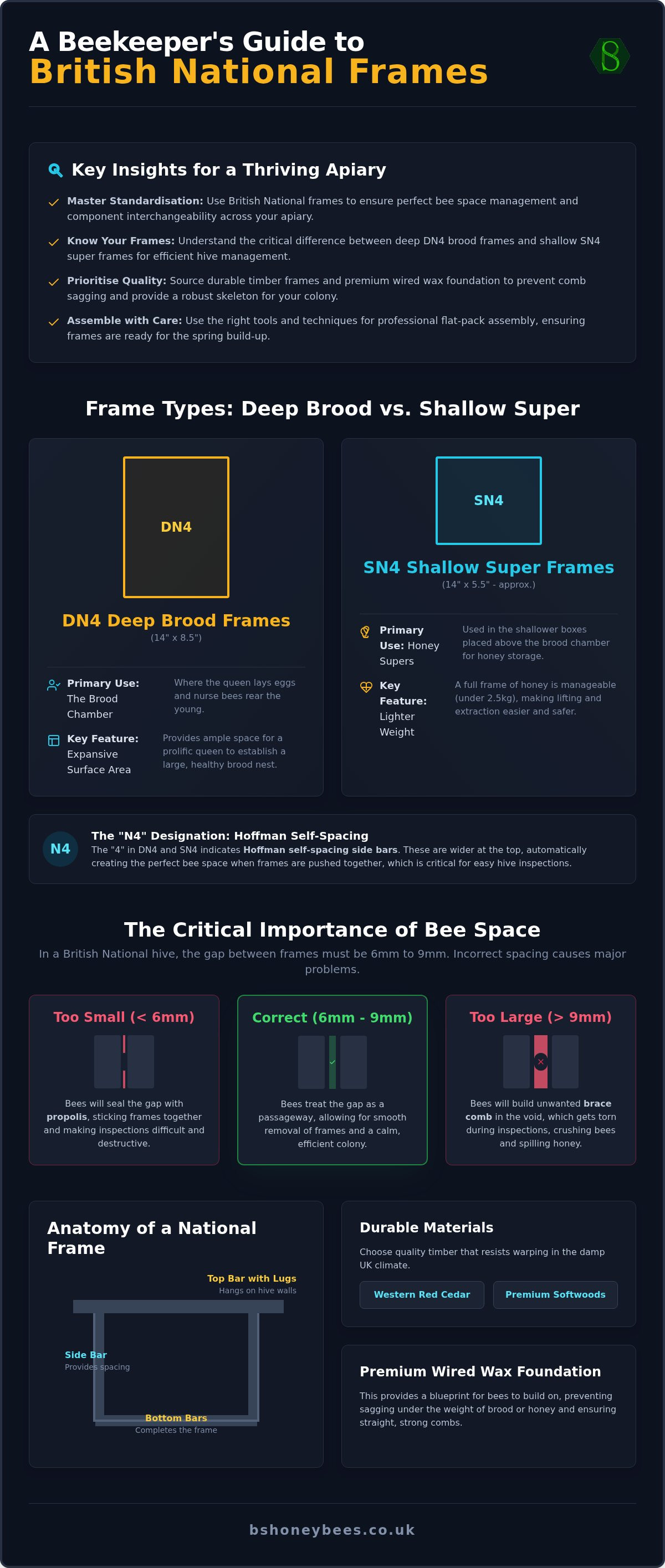
A standard frame consists of a top bar, two side bars, and two bottom bars. The top bar features extended "lugs" at each end, which are the defining characteristic of the National standard. These lugs allow the frame to hang securely on the hive walls while remaining easy to lift during inspections. High-quality Western Red Cedar or premium softwoods remain favourites amongst UK beekeepers because they offer durability and resist warping in our damp climate. The History of the hive frame shows how these specific dimensions became standardised to allow for interchangeable parts across different apiaries, ensuring that a frame from one supplier fits perfectly into a box from another.
Understanding Bee Space in the UK Apiary
Precision is vital for successful hive management. Bee space is the critical gap bees leave for movement without building comb. In a British National hive, this gap is strictly maintained between 6mm and 9mm. If the space is smaller than 6mm, bees will seal it shut with propolis. If it's larger than 9mm, they'll fill the void with bridge or brace comb. Using non-standard british national frames uk creates a logistical nightmare during the active season. It leads to stuck frames, crushed bees, and messy inspections that frustrate both the keeper and the colony. Correct spacing ensures you can lift frames smoothly without tearing through excess wax or damaging delicate queen cells.
The relationship between the frame, the wax foundation, and the colony is symbiotic. The frame acts as a rigid border, while the foundation provides the blueprint for the bees to build their cells. By choosing the right hardware, you allow your bees to focus their energy on foraging and honey production rather than repairing structural gaps or clearing unwanted brace comb. This efficiency is what separates a productive apiary from one plagued by maintenance issues.
DN4 vs SN4: Choosing Between Deep and Shallow Frames
Selecting the correct british national frames uk hardware is the next logical step once you've established your hive's skeleton. Beginners often find the alphanumeric codes confusing, but the logic is straightforward once you break it down. The letters "D" and "S" represent Deep and Shallow, whilst "N" signifies the National standard. The number "4" is perhaps the most critical part of the code for new beekeepers. It indicates a Hoffman self-spacing side bar. These side bars are manufactured with a wider profile at the top, ensuring that when frames are pushed together, they maintain the perfect bee space automatically. Following National Bee Unit guidelines on hive hygiene and colony management starts with getting these fundamental components right.
DN4 British National Deep Frames for the Brood Chamber
The brood chamber is the engine room of the colony where the queen lays her eggs and the nurse bees tend to the larvae. For this vital area, you must use DN4 British National Deep Frames (Flat). These frames measure 14 inches by 8.5 inches, providing the expansive surface area required for a prolific queen to build a healthy brood nest. Because these dimensions are the UK industry standard, they are the exact frames found in the honey bee nucs for sale UK providers supply. Buying them in flat-pack form is a smart logistical move; it allows for compact storage in the shed during the winter months and ensures you can assemble them with fresh, aromatic foundation just before the spring build-up begins.
SN4 British National Super Frames for Honey Production
When the nectar flow starts, you'll add supers to the top of your brood nest. These boxes are shallower than the brood chamber, requiring SN4 British National Super Frames (Flat). Shallow frames are preferred for honey storage because a full deep frame of honey can weigh over 2.5kg. A full brood box of honey is often too heavy for a single beekeeper to lift safely. SN4 frames are lighter, easier to handle, and designed to fit perfectly into standard UK centrifugal honey extractors. Using the same self-spacing "4" style side bars in your supers keeps your equipment consistent. It eliminates the need for fiddly plastic ends and prevents frames from shifting whilst you move hives to different forage sites.
For a standard British National hive, you'll typically require 11 frames per box if you're using a dummy board, or 12 frames if you're filling the space entirely. It's a professional best practice to always have at least one full box of spare frames ready. You can stock up on premium frames and wax to ensure you're never caught short during a sudden, heavy nectar flow. Preparedness is the hallmark of a successful beekeeper; don't wait for the bees to run out of space before ordering your next set of frames.
The Importance of Premium Wired Wax Foundation
While the wooden components provide the border, the wax foundation provides the roadmap. In the temperamental UK climate, wired wax is the only sensible choice for your british national frames uk setup. Foundation isn't just a space-filler; it's a structural blueprint that dictates how efficiently your bees build their home. Choosing high-quality foundation ensures that the comb remains straight, uniform, and robust enough to handle the rigours of a busy season. The British Beekeepers Association often highlights the importance of using fresh, clean wax to maintain colony health and productivity.
Wired foundation is considered the gold standard because of the vertical wires embedded within the wax. These wires act like rebar in concrete, preventing the wax from sagging or buckling when hive temperatures rise during a summer heatwave. Without this internal support, the weight of the bees and the developing brood can cause the comb to distort. Vibrant, deep yellow colouring in your wax is a primary indicator of freshness and purity. Bees are far more likely to draw out comb quickly on fresh, aromatic wax than on old, brittle sheets that have lost their scent. High-purity wax also ensures that you aren't introducing unwanted contaminants into the hive environment.
British National DN4 Wired Deep Foundation
The brood nest is a heavy, active environment that requires maximum structural support. Using British National DN4 Wired Deep Foundation at £15.6 per pack provides the necessary strength for a developing colony. This foundation is designed to withstand the weight of thousands of larvae and the constant movement of nurse bees. Professional breeders specifically choose this grade of wax when establishing colonies for F1 buckfast queens UK because a prolific queen needs perfectly drawn cells to reach her full laying potential. If the foundation sags, it creates irregular drone cells that can disrupt the balance of the brood nest.
British National SN4 Wired Shallow Foundation
In the honey supers, the challenges are different but equally demanding. When you use British National SN4 Wired Shallow Foundation, you're preparing for the intense forces of the honey extractor. During centrifugal extraction, unwired wax often collapses or shatters, leading to wasted honey and ruined equipment. Wired shallow foundation keeps the comb intact, allowing you to spin the frames at high speeds to remove every drop of honey. For the 2026 season, buying these in packs of 10 is the most cost-effective way to manage your british national frames uk inventory. It ensures you have consistent, high-quality wax ready the moment a heavy nectar flow begins.
Essential Tools and Techniques for Frame Assembly
Winter is the favourite time for UK beekeepers to retreat to the shed or workshop for frame assembly. It's a methodical task that prepares you for the frantic pace of the spring build-up without the pressure of active hive management. By choosing to build your own british national frames uk, you gain total control over the stability of your hive's interior. You'll need a small tack hammer, a set square, and a frame jig. The jig is particularly helpful for maintaining alignment when working through a large batch of components. Always begin with the top bar, followed by the side bars. Only insert the foundation once the frame is partially constructed to avoid damaging the delicate wax sheets whilst you hammer the joints.
Softwood is a traditional choice for frames because it's lightweight and easy to handle, but it requires a delicate touch. A common mistake is nailing too close to the edge of the timber. This often splits the wood and ruins the component. Position your pins carefully to ensure a clean, strong bond that will last for several seasons. Precision during this stage prevents frame failure later when the boxes are heavy with honey and brood.
The Role of Specialist Gimp Pins
Don't reach for standard household nails. Their thick gauge will almost certainly split the thin bars of a National frame. Use Gimp Pins Frame Nails instead. These are designed specifically for beekeeping hardware. A 100g bag is perfect for a few hives, whilst a 500g box offers better value for those managing larger apiaries. When you're ready to secure the wax, make sure the foundation is tucked firmly into the top bar groove. Nailing the wedge bar securely over the wax ensures the sheet stays vertical and doesn't buckle as the bees begin to draw it out.
Maintaining Squareness and Stability
Stability depends on squareness. If your frames are wonky, they won't hang straight on the hive runners. This creates irregular gaps that the bees will inevitably fill with propolis or brace comb. Check for "twist" by looking down the length of the side bars. If they aren't parallel, the frame will be difficult to move during future inspections. Use at least four gimp pins per frame for maximum structural integrity. This provides the strength needed to resist the prying force of a hive tool when the colony has glued the frames together with propolis during the height of summer.
Buy your flat-pack frames and assembly supplies now to ensure your apiary is fully prepared for the first nectar flow of the 2026 season.
Sourcing the Best British National Frames in the UK
Sourcing your british national frames uk requirements involves prioritising material integrity over the lure of a bargain price. Low-cost alternatives often utilise timber with excessive knots or irregular grain. When subjected to the weight of a heavy honey crop, these weak points lead to snapping or warping, which complicates extraction and routine maintenance. Partnering with a specialist like BS Honey Bees Ltd guarantees that your hardware meets the precise tolerances necessary for a successful 2026 season. High-quality cedar or clear pine components resist the damp British climate and survive multiple seasons of cleaning without failing.
Premium frames are the essential counterpart to high-performance colonies. As discussed in our comparison of buckfast vs carniolan bees, a prolific queen requires a flawless environment to maximise her laying potential. If your frames are structurally unsound, you risk hindering the productivity of your most valuable livestock. From a logistical standpoint, choosing a dedicated UK supplier ensures that delicate components, particularly wired wax, are handled with the care required for nationwide delivery. This reliability allows you to focus on colony management rather than equipment failure.
Why Quality Frames Improve Honey Yields
Superior craftsmanship in frame manufacturing translates directly into higher honey yields. When frames are perfectly standardised, bees can focus on storage rather than bridging gaps with excess wax. The Hoffman self-spacing design is vital here, as it maintains the exact distance required to avoid crushing bees during box manipulation. Premium frames are also built to withstand the rigours of the cleaning cycle. They endure the temperatures of solar wax extractors or steam cleaners, allowing you to reuse the timber for several seasons without the wood becoming brittle or losing its shape.
Ready for the 2026 Season?
The spring build-up occurs rapidly, so having your inventory ready is non-negotiable. Audit your stores now to ensure you have sufficient DN4 and SN4 components for potential swarms or unexpected nectar flows. Many professional beekeepers choose to synchronise their hardware upgrades with the introduction of mated queen bees UK, creating a fully standardised environment from the outset. This methodical approach to equipment sourcing minimises operational friction and supports the long-term health of the apiary.
Invest in hardware that supports your colony's growth. Browse the full Frames & Wax collection at BS Honey Bees Ltd to secure professional-grade supplies for your hives.
Secure Your Apiary’s Foundation for 2026
Mastering your internal hive hardware is the most effective way to streamline your beekeeping operations. By choosing the correct DN4 and SN4 standards, you ensure perfect bee space and eliminate the frustration of stuck frames or collapsed comb. High-quality british national frames uk provide the structural reliability your colonies need to thrive during the intense nectar flows of the coming season. Remember that premium wired wax foundation isn't just an extra; it's a critical safeguard against sagging and distortion in the summer heat.
Don't wait for the spring build-up to discover your equipment is insufficient. We provide premium DN4 and SN4 frames from £16.5 alongside wired wax foundation for maximum stability. With fast nationwide UK delivery for all beekeeping hardware, you can prepare your workshop today with total confidence. Shop the British National Frames & Wax Collection to guarantee your bees have the best possible start. Your commitment to quality hardware today will be rewarded with easier inspections and healthier colonies tomorrow.
Frequently Asked Questions
What is the difference between DN4 and DN5 British National frames?
The primary difference lies in the width and spacing method of the side bars. DN4 frames feature Hoffman self-spacing side bars that automatically maintain the correct gap between frames when pushed together. In contrast, DN5 frames have a wider top bar and straight side bars, which usually require plastic ends or castellated spacers to manage the bee space. Most UK hobbyists prefer the DN4 for its simplicity and efficiency during hive inspections.
How many frames do I need for a standard British National brood box?
A standard British National brood box typically holds 11 frames alongside a wooden dummy board. This configuration is the professional choice because the dummy board makes it much easier to remove the first frame without crushing bees. If you choose not to use a dummy board, you can fit 12 frames tightly into the chamber. Always ensure the frames are pushed together firmly to maintain the correct internal geometry.
Do British National frames come with the wax foundation included?
No, British National frames are almost always sold as wooden components only, with the wax foundation purchased separately. This allows you to choose between worker-sized cells, drone base, or thin sections for cut comb honey. It also ensures the wax is as fresh as possible when you assemble your british national frames uk inventory. Fresh wax is more aromatic and encourages the bees to draw out the comb much faster.
Can I use SN4 frames in a brood box if I am running a "brood and a half" system?
Yes, SN4 frames are the standard choice for the shallow box in a "brood and a half" management system. This setup uses one deep brood box and one shallow super to provide the queen with extra laying space. Because the bees will use these shallow frames for brood rearing rather than honey storage, it's essential to use wired brood-grade wax foundation to support the weight of the developing larvae and pollen.
What are gimp pins and why are they used for beehive frames?
Gimp pins are specialised, thin-gauge nails designed to secure the wooden joints of a beehive frame without splitting the softwood. Standard household nails are often too thick and will cause the top or side bars to crack upon impact. These pins are also used to secure the wedge bar, which holds the wax foundation firmly in place. Using at least four pins per frame ensures the assembly remains rigid under heavy loads.
How often should I replace the frames and wax in my National hive?
You should aim to replace your brood wax foundation every two to three years to maintain hive hygiene and reduce the buildup of pathogens. The wooden frames themselves can last much longer if they are cleaned of propolis and wax during the winter. However, if a frame becomes warped, cracked, or heavily stained with old cocoons, it's best to replace the entire unit to ensure your british national frames uk setup remains efficient.
Why is my wax foundation sagging after I have assembled the frames?
Sagging usually occurs if the wax foundation wasn't secured tightly enough during assembly or if you used unwired wax in a warm environment. If the wedge bar is loose, the wax sheet can slip downwards, leading to distorted cells. Ensure the wax is tucked firmly into the top bar groove and that the vertical wires are properly supported. Always store your assembled frames in a cool, flat position until they are ready for the hive.
Is it better to buy flat-pack frames or pre-assembled ones for a UK apiary?
Buying flat-pack frames is generally the better option for UK beekeepers because they are more cost-effective and easier to ship without damage. Flat-packs allow you to store a large inventory in a small space, which is perfect for winter preparation. Whilst pre-assembled frames offer immediate convenience, they are more prone to breaking during transit and take up much more room in the shed. Assembly also provides a better understanding of hive geometry.